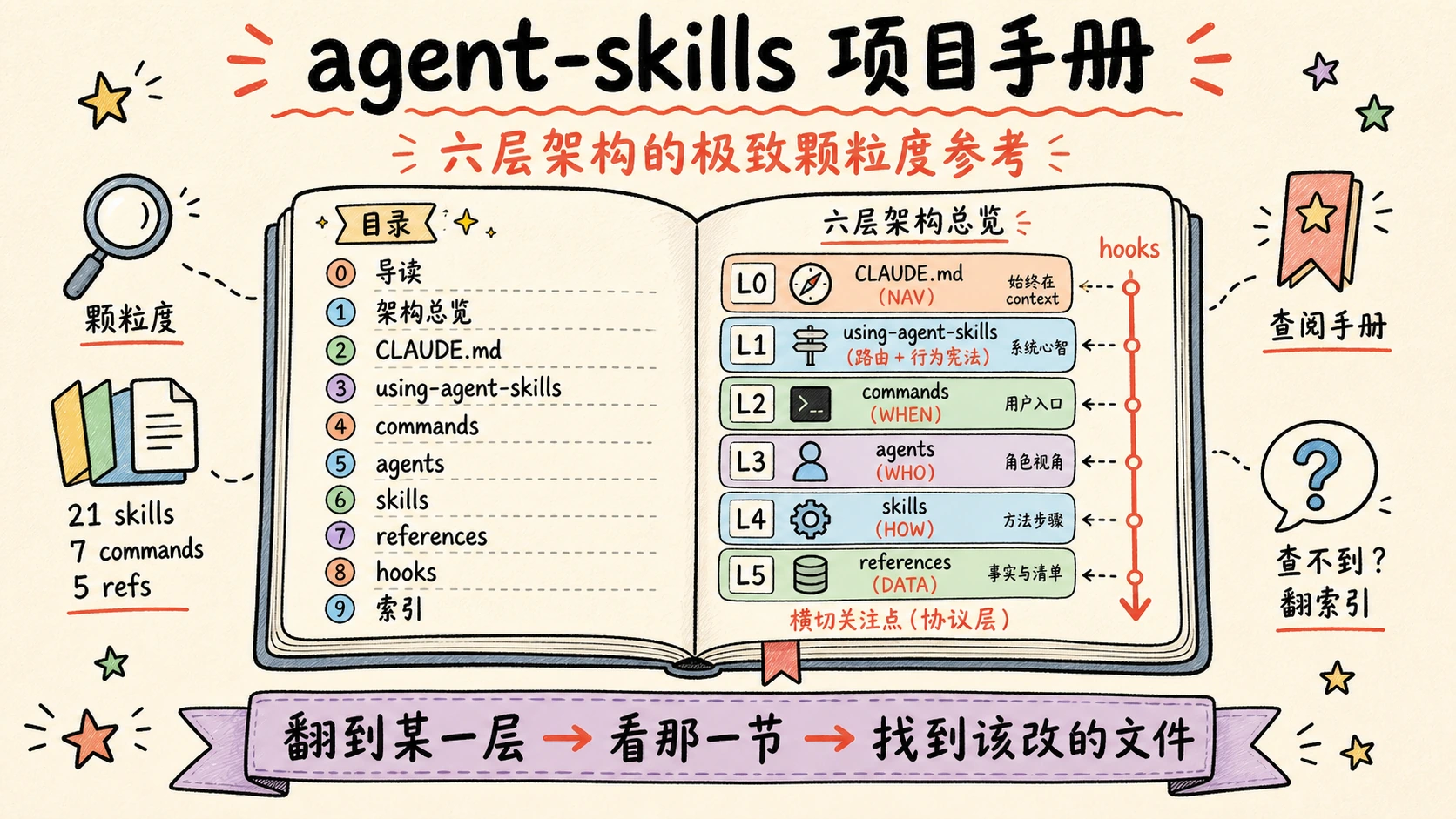
本手册是 《从使用者到学习者:agent-skills 架构深度剖析与高手思维体系》 的配套参考。文章型负责讲清楚"为什么",本手册负责讲清楚"是什么、在哪里、如何展开"。
适用场景:回顾某一层的具体设计、查阅某个文件的角色、在自己的项目里复刻某一层时作为模板。

导读|如何使用本手册
本手册按 agent-skills 的层级组织,每节自包含。建议查阅方式:
- 想了解整体结构 → 第 1 节《架构总览》
- 想查某一层 → 直接跳对应层级
- 想找设计模式 → 翻每节末尾的"经验与可复用模板"
每一节的固定结构:
- 定位与体量 — 该层在系统中的角色、文件数、行数
- 完整结构 — 目录树、文件清单
- 核心机制 — 关键文件逐项拆解
- 设计取舍 — 为什么这么设计
- 注意事项 — 容易踩的坑
- 经验与可复用模板
本手册的写法是客观第三人称。文章型《从使用者到学习者》是鬼哥的笔记体;如果你想读叙事版本,请翻 文章型。
1. 架构总览
1.1 项目定位
agent-skills 是一个给 AI 编程代理使用的工程方法论文件包,由 Google 资深工程师 Addy Osmani 开源在 github.com/addyosmani/agent-skills。它不是工具、不是框架、不是 SDK——它是一组结构化的 Markdown 文件 + 少量 Bash hook 脚本,靠 Claude Code 这类 AI agent runtime 的"skill 自动加载"+“slash command”+“hook"机制生效。
1.2 完整目录树
| |
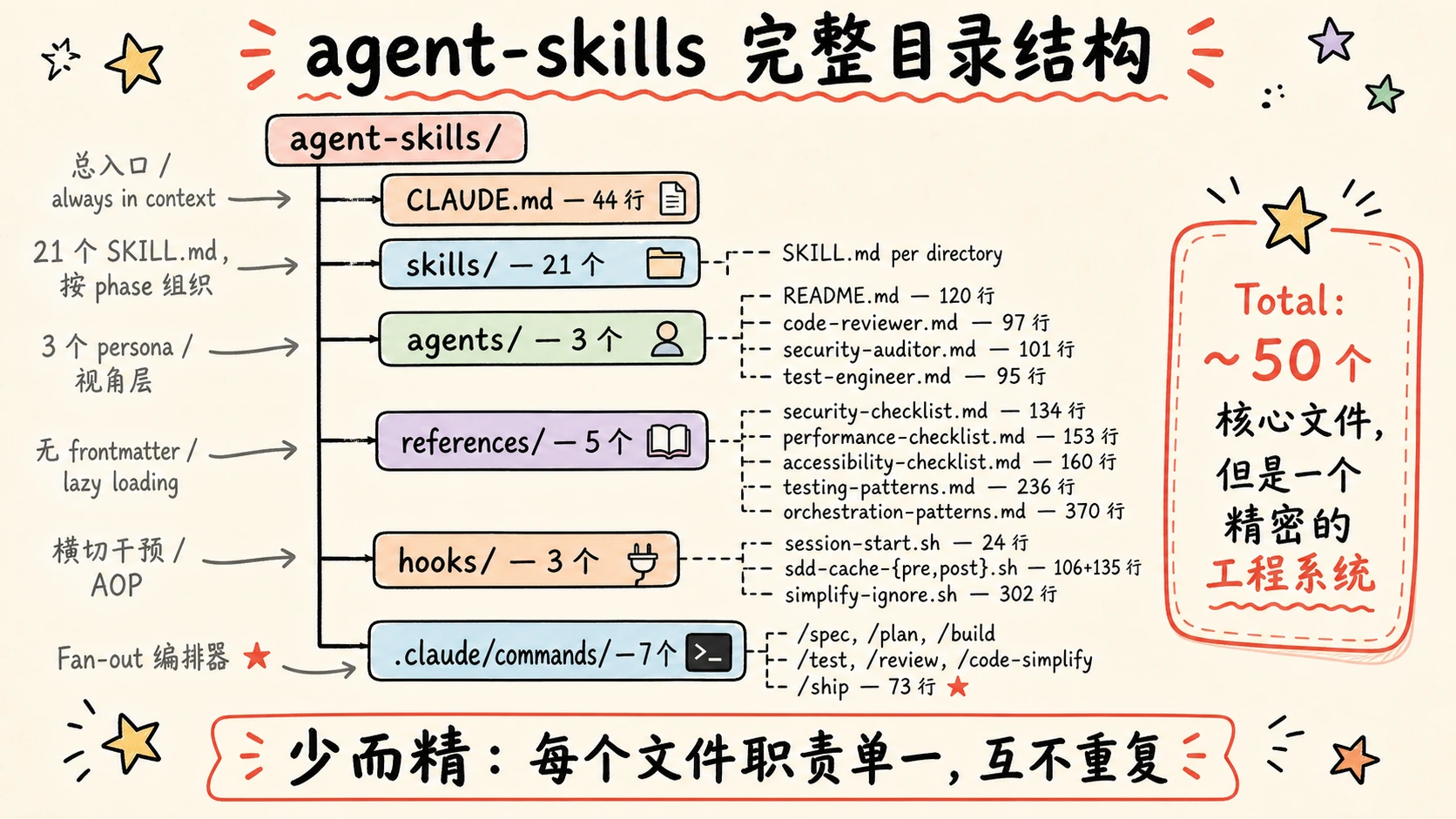
1.3 六层架构 + 横切 hooks
| 层 | 名称 | 职责 | 加载时机 | 数量 | 约定体量 |
|---|---|---|---|---|---|
| Layer 0 | CLAUDE.md | 仓库总入口(NAV) | always in context | 1 | 44 行 |
| Layer 1 | using-agent-skills | 路由 + 行为宪法 | session start hook 注入 | 1 | ~180 行 |
| Layer 2 | .claude/commands/ | 用户显式入口(WHEN) | 用户 / 触发 | 7 | 15-75 行 |
| Layer 3 | agents/ | 视角与输出格式(WHO) | command 派发或显式调用 | 3 | ~100 行 |
| Layer 4 | skills/ | 流程方法论(HOW) | 描述匹配或显式调用 | 21 | 100-300 行 |
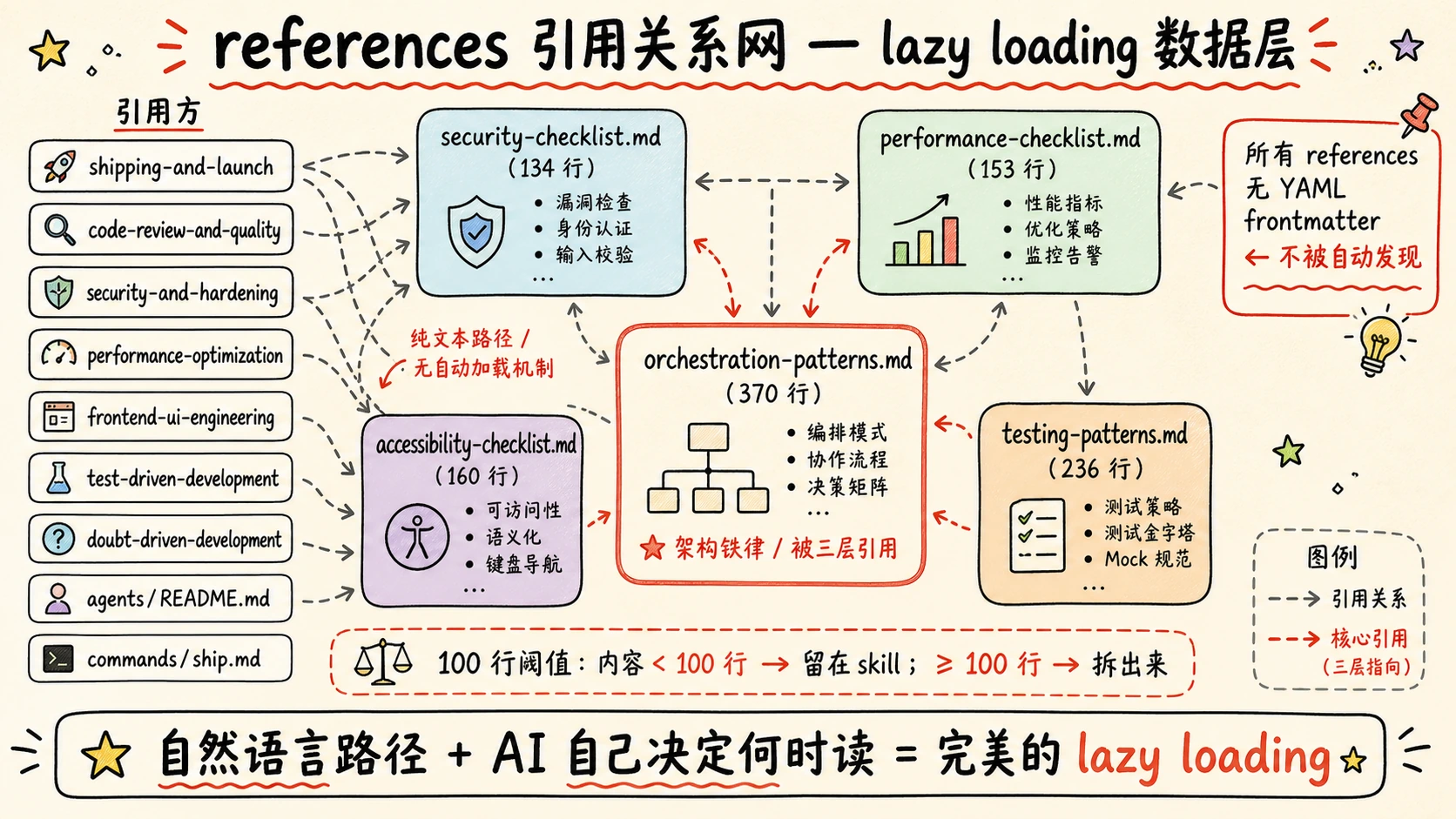
| Layer 5 | references/ | 清单与模式(DATA) | skill 文件指向后按需 Read | 5 | 134-370 行 |
| Layer X | hooks/ | 横切干预(AOP) | 事件触发 | 3 | 24-302 行 |
1.4 跨层引用关系网
| 出方 | 入方 | 引用方式 |
|---|---|---|
| CLAUDE.md | skills/* | 列名 + schema 强制 |
| using-agent-skills | skills/* | 决策树 + 名称 |
| commands/* | skills/* | Invoke the agent-skills:X skill |
| commands/ship.md | agents/* | subagent_type: code-reviewer |
| agents/* | skills/* | 通过 README 中的 Composition 块 |
| agents/* | references/orchestration-patterns.md | 文本路径 |
| skills/test-driven-development | references/testing-patterns.md | 文本路径 |
| skills/shipping-and-launch | references/{security,performance,accessibility}-checklist.md | 文本路径 |
| skills/frontend-ui-engineering | references/accessibility-checklist.md | 文本路径 |
| skills/code-review-and-quality | references/{security,performance}-checklist.md | 文本路径 |
| skills/security-and-hardening | references/security-checklist.md | 文本路径 |
| skills/performance-optimization | references/performance-checklist.md | 文本路径 |
| skills/doubt-driven-development | references/orchestration-patterns.md | 文本路径(×2) |
| hooks/session-start.sh | skills/using-agent-skills | 运行时 cat 注入 |
| hooks/sdd-cache-*.sh | skills/source-driven-development | 拦截 WebFetch |
| hooks/simplify-ignore.sh | skills/code-simplification | 拦截 Read/Edit/Write |
1.5 token 加载预算
| 加载阶段 | 内容 | 体量 |
|---|---|---|
| Session 启动后立刻 | CLAUDE.md | 44 行 |
| Session 启动 hook 注入 | using-agent-skills | ~180 行 |
用户触发 /command | 对应命令 + 关联 skill | 15-75 + 100-300 行 |
| AI 决策时按需读取 | 具体 skill | 100-300 行 |
| AI 执行 skill 时按需读取 | 关联 reference | 134-370 行 |
整套设计的核心:总在 context 的东西必须极短,越深的层加载得越少。
2. Layer 0|CLAUDE.md
2.1 定位与体量
- 文件路径:仓库根目录
CLAUDE.md - 行数:44 行
- 加载时机:所有 Claude Code session always in context
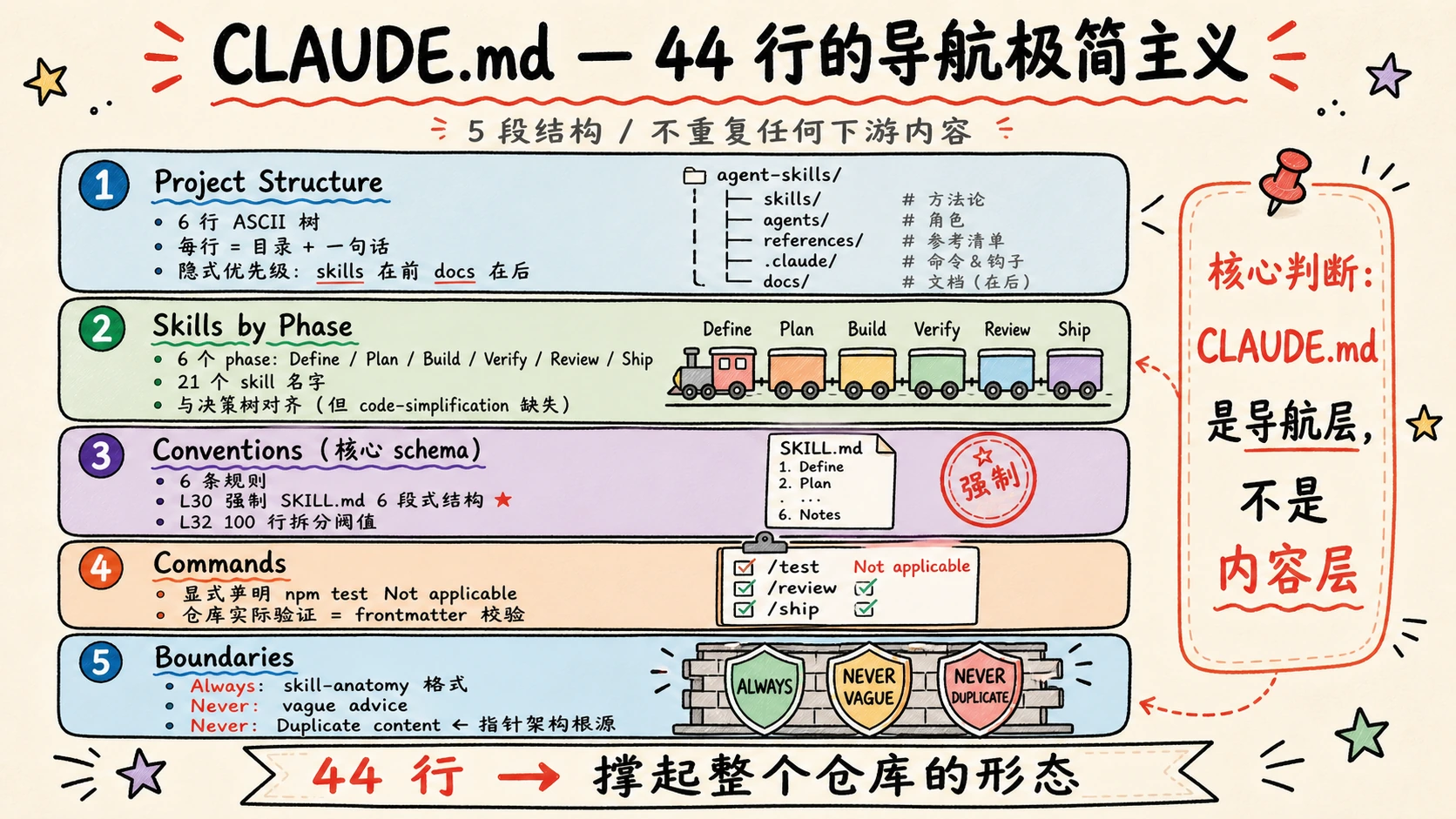
- 角色:仓库的"总入口 / 物理导航 / schema 强制者”
- 不做的事:不重复任何下游内容、不教学、不解释动机
2.2 完整结构(5 段)
| |
2.3 五段逐节拆解
2.3.1 Section 1: Project Structure
| |
设计细节:
- 每行右侧括号里直接列名:
agents/后面列出三个 persona 名,commands/直接列出 7 个命令——AI 不需要再ls一次目录 - 隐式优先级:skills/ 排第一,docs/ 排最后——AI 会先把注意力放到上面
.claude/commands/用全路径:因为它不在仓库根目录的一级——避免 AI 找错路径
2.3.2 Section 2: Skills by Phase
| |
对齐关系: 这一段与 using-agent-skills/SKILL.md 的路由树完全对齐——都是 6 个阶段、同样的命名、同样的归属。
已知不一致:code-simplification 出现在本节的 Review 阶段,但 using-agent-skills 决策树里没有出现。这是仓库中存在的真实不一致点。
2.3.3 Section 3: Conventions(核心 schema)
| |
6 条规则可以拆为三类:
| 类型 | 规则 | 作用 |
|---|---|---|
| 文件位置 | “Every skill lives in skills/ | 物理约束 |
| 文件头部 | “YAML frontmatter with name and description” | frontmatter 约束 |
| 文件头部 | “Description starts with…” | 描述写法 |
| 文件结构 | “Every skill has: Overview, When to Use, Process, Common Rationalizations, Red Flags, Verification” | 核心 schema |
| 跨文件 | “References are in references/, not inside skill directories” | 分层约束 |
| 跨文件 | “Supporting files only created when content exceeds 100 lines” | 拆分阈值 |
第 4 条是真正的核心——它定义了 SKILL.md 的 6 段式结构,整个仓库 21 个 skill 必须都长这样。
例外:
using-agent-skills/SKILL.md本身不遵守这个 schema,它有自己的特殊段(Skill Discovery、Core Operating Behaviors、Failure Modes、Lifecycle Sequence),见 Layer 1。
2.3.4 Section 4: Commands
| |
只有 2 行,设计意图:
- 显式声明 “Not applicable”:很多模板会留空,导致 AI 浪费时间猜测;这里直接告诉 AI “别想跑 npm test”
- 替代验证方式:给出仓库实际的"测试"是 frontmatter 校验——这是文档型仓库的特殊做法
2.3.5 Section 5: Boundaries
| |
3 条规则,其中:
| 规则 | 防止什么 |
|---|---|
| Always: skill-anatomy 格式 | 防止贡献者发明新结构 |
| Never: vague advice | 防止 skill 变成空话 |
| Never: duplicate content | 防止跨 skill 内容漂移 |
第 3 条 “Never: Duplicate content” 是整个仓库的"指针架构"根源——它直接驱动了:
- commands 委托给 skills(不复制方法论)
- skills 委托给 references(不内嵌清单)
- personas 委托给 skills(不复制流程)
- hooks 委托给协议(不发明新通信机制)
2.4 设计取舍
取舍 1: CLAUDE.md 是"导航层",不是"内容层"
最关键的设计判断:CLAUDE.md 不重复任何下游内容。
CLAUDE.md 每次对话都会自动加载到 context——每多写一行就有 N 次重复的 token 成本。所以它必须极致克制。
取舍 2: 三段式 Boundary 而非四段式
spec-driven-development 自身倡导三层 boundary(Always / Ask first / Never),但 CLAUDE.md 只用了两层(Always / Never),省掉了 Ask first。
可能的解释:CLAUDE.md 定义的是"贡献新 skill 时不可协商的约束",没有"协商空间";“Ask first” 适合业务边界,不适合结构约束。
2.5 注意事项
- Conventions 第 4 条的 schema 不允许例外——但
using-agent-skills自己破坏了它。这种"meta-skill 的例外"没有在 CLAUDE.md 明确声明,是隐性约定 - “skill-anatomy.md” 引用没给出路径——AI 找它需要靠 grep
- Skills by Phase 与决策树不一致(
code-simplification缺失)——维护时需要双地更新
2.6 经验与可复用模板
可复用的 CLAUDE.md 模板
| |
核心原则:
- 总长度 < 60 行
- 只放"AI 入仓必须知道"的信息
- 不放教程、不放示例、不放动机说明
- 任何超过一行的内容都应该拆到下游文件
3. Layer 1|using-agent-skills
3.1 定位与体量
- 文件路径:
skills/using-agent-skills/SKILL.md - 行数:~180 行
- 加载时机:每个新会话由
hooks/session-start.sh强制注入 - 角色:路由器 + 行为宪法(meta-skill)
- 特殊性:它是唯一一个不遵守 CLAUDE.md 6 段式 schema 的 skill
3.2 双重职责
3.2.1 职责一:Skill Router(路由器)
完整决策树(位于 SKILL.md 第 14-39 行):
| |
设计细节:
| 选择 | 理由 |
|---|---|
| 树形结构而非列表 | 强迫读者走唯一路径,列表会让人想选多个 |
| 父节点 → 子节点细化 | 实现代码 下嵌套 UI/API/Context,符合 AI 的层次推理习惯 |
| 问句触发而非任务描述 | “Something broke?” 比 “debugging task” 更贴近真实对话 |
已知盲区:
code-simplification没有出现在树里(只在 Quick Reference 表里)deprecation-and-migration没有出现在树里
3.2.2 职责二:Core Operating Behaviors(行为宪法)
6 条不可协商的行为约束:
| |
每一条都精确对抗一个 AI 缺陷:
| 行为 | 对抗的 AI 缺陷 |
|---|---|
| 1. Surface Assumptions | “静默填充"歧义 |
| 2. Manage Confusion Actively | 矛盾时"就近取一” |
| 3. Push Back | 奉承倾向(sycophancy) |
| 4. Enforce Simplicity | 过度工程化倾向 |
| 5. Scope Discipline | “顺手重构"倾向 |
| 6. Verify, Don’t Assume | “看起来对就完成了"倾向 |
每一条都有:正例/反例对比 + 具体的判断触发词(如 “quantify when possible”、“Would a staff engineer say…")。这是让约束真正可执行的关键。
3.3 Failure Modes(10 条失败模式)
文件末尾还有一份 10 条 Failure Modes(位于 SKILL.md 第 110-123 行),与 6 条行为形成镜像:
| |
镜像关系:
- 行为 1(Surface Assumptions)→ 失败 1+3
- 行为 3(Push Back)→ 失败 5
- 行为 5(Scope Discipline)→ 失败 7+8+9
- 失败 4(不呈现 tradeoff)没有对应的正面行为 ← 这是一个缺口
分工:
- Common Rationalizations → 处理"AI 的借口”(主动跳过的想法)
- 10 条失败模式 → 处理"AI 的症状”(已经在跳过的迹象)
3.4 Skill Rules(4 条)
| |
3.5 Lifecycle Sequence
文件提供了一份"完整功能"的典型 skill 调用序列(位于 SKILL.md 第 137-153 行):
| |
关键注释:“Not every task needs every skill. A bug fix might only need: debugging-and-error-recovery → test-driven-development → code-review-and-quality.”
这一行避免了 AI 死板地套流程。
3.6 Quick Reference 表
文件最后是一份 Quick Reference 表(位于 SKILL.md 第 159-180 行),列出全部 21 个 skill 的 phase + name + 一句话总结。这是仓库中唯一一份完整覆盖所有 skill 的速查表。
3.7 设计取舍
取舍 1: 不遵守自己倡导的 schema
using-agent-skills 本身不遵守 CLAUDE.md 第 30 行的 6 段式 schema。它有:
- Overview
- Skill Discovery(独有)
- Core Operating Behaviors(独有)
- Failure Modes to Avoid(独有)
- Skill Rules(独有)
- Lifecycle Sequence(独有)
- Quick Reference(独有)
理由:meta-skill 是元层,不是被治理对象,可以例外。但这一例外没在 CLAUDE.md 显式声明。
取舍 2: 路由 + 治理放一起
为什么不拆成两个 skill?因为它们的服务对象重叠——都是为了让 AI 在每个任务的开始就做对决策。拆开后 AI 需要同时加载两份。
3.8 注意事项
- 决策树缺失
code-simplification和deprecation-and-migration——AI 走树时这两个 skill 可能被忽略 - 6 条行为是"硬约束”,但文件没有声明优先级冲突时怎么办(例如"Push Back" vs “Scope Discipline”——发现 scope 外问题该不该指出?)
- Lifecycle Sequence 容易被 AI 当成必走流程,但作者明确写了"Not every task needs every skill"
3.9 经验与可复用模板
Meta-skill 应该包含的元素
| |
4. Layer 2|.claude/commands/
4.1 定位与体量
- 目录路径:
.claude/commands/ - 文件数:7 个
.md文件 - 行数范围:15-75 行(除 ship 外均极度克制)
- 加载时机:用户输入
/<name>时触发 - 角色:用户显式入口 + skill 激活快捷键
4.2 完整命令清单
| 命令 | 行数 | 主调 skill | 模式 |
|---|---|---|---|
/spec | 17 | spec-driven-development | 单 skill 包装 |
/plan | 16 | planning-and-task-breakdown | 单 skill 包装 |
/build | 19 | incremental-implementation + TDD | 双 skill 并联 |
/test | 20 | TDD(+ browser-testing 条件) | 主 skill + 兜底 |
/review | 17 | code-review-and-quality | 单 skill 包装 |
/code-simplify | 23 | code-simplification | 单 skill 包装 |
/ship | 73 | shipping-and-launch + 3 personas | Fan-out 编排器 |
4.3 命令文件结构
所有 7 个命令文件遵循同一模板:
| |
Frontmatter 的极简主义: 7 个命令的 frontmatter 都只有一个字段 description。对比 Claude Code 支持的完整字段(allowed-tools、argument-hint、model、disable-model-invocation),这里全部省略。
4.4 四种命令模式
4.4.1 模式 1:单 skill 包装(5 个)
/spec、/plan、/review、/code-simplify 都是这种形态。例:spec.md 完整内容(17 行):
| |
4.4.2 模式 2:双 skill 并联(/build)
| |
关键设计:/build 把"实现"和"测试"绑成一个动作,强制 RED-GREEN-REFACTOR 循环。单独跑实现不写测试是常见反模式,命令层在源头阻止它。
4.4.3 模式 3:主 skill + 条件兜底(/test)
| |
最后一句是条件式 escalation——“如果是浏览器问题,再加挂这个 skill”。
4.4.4 模式 4:Fan-out 编排器(/ship)
这是 7 个命令里唯一超过 70 行的,因为它做的事在 skill 里做不优雅:并行调度 3 个 subagent。
完整 Phase A 引文:
Spawn three subagents concurrently using the Agent tool. Issue all three Agent tool calls in a single assistant turn so they execute in parallel — sequential calls defeat the purpose of this command.
3 个 subagent:
code-reviewer— 五维 review(correctness / readability / architecture / security / performance)security-auditor— OWASP Top 10 + secrets + auth/authz + CVEstest-engineer— 测试覆盖分析
关键约束:
- 三个 Agent 调用必须在一个 assistant turn 里发出(否则失去并行性)
- Subagents cannot spawn other subagents(平台约束)
- 三个 subagent 各自返回 report,主 agent 在 Phase B 合并
Persona 优先级: “If you’ve defined your own code-reviewer, security-auditor, or test-engineer in .claude/agents/ or ~/.claude/agents/, those take precedence over this plugin’s versions.”
Phase B 合并维度(6 项):
- Code Quality
- Security
- Performance
- Accessibility(不由 personas 覆盖,主 agent 直接处理)
- Infrastructure
- Documentation
Phase C 输出模板:
| |
5 条强制规则:
- Phase A 三个 persona 并行运行,绝不串行
- Persona 不能互相调用
- Rollback plan 在 GO 决策前是必须的
- 任何 Critical finding 默认 NO-GO,除非用户显式接受风险
- Skip fan-out 的条件(必须同时满足):改动 ≤ 2 个文件、diff < 50 行、不涉及 auth/payments/data access/config/env
4.5 Command vs Skill 的本质区别
| 维度 | Skill | Command |
|---|---|---|
| 谁加载 | 自动/按需 | 用户显式触发 |
| 内容 | 完整方法论(100-300 行) | 调用配方(15-25 行) |
| 写给谁看 | AI 模型 | 模型 + 人(用户要 type) |
| 触发方式 | 描述匹配 | / 前缀精确匹配 |
| 复用方向 | 横向通用 | 项目特定 |
4.6 命令覆盖图
有命令的 7 个 skill:
| |
没有命令的 15 个 skill:
| |
判定逻辑:
- 有命令 = 用户高频显式触发 + 是多 skill 组合的入口
- 无命令 = 自动激活更合适 / 是子能力 / 是兜底能力
4.7 命令命名的语义学
每个命令名都对应一个具体的可交付物:
| 命令 | 隐含承诺产物 |
|---|---|
/spec | SPEC.md |
/plan | tasks/plan.md + tasks/todo.md |
/build | 代码 + 测试 + commit |
/test | passing tests |
/review | review report |
/code-simplify | simplified diff |
/ship | GO/NO-GO + rollback plan |
没有 /think、/explore 这种没有产物的命令——这是一种纪律。
4.8 注意事项
/test与/build内部都调用 TDD——存在重叠。连续跑/build时 TDD skill 会被重复激活/ship的 skip-fan-out 条件可能弱化纪律——任何上线都应该跑完整 checklist,但这个 “skip” 选项允许小改动跳过- 没有
/debug命令——debugging-and-error-recovery只能在/build失败时被调用,用户独立遇到 bug 想触发 prove-it 流程时没有专用命令 - 没有
/docs命令——documentation-and-adrs没有显式入口,文档容易被遗忘
4.9 可复用 Command 模板
| |
5. Layer 3|agents/
5.1 定位与体量
- 目录路径:
agents/ - 文件数:3 个 persona + 1 个 README
- 总行数:413 行
- 加载时机:作为 subagent system prompt(被 command 或用户调用时)
- 角色:定义"WHO"——视角与输出格式
5.2 完整文件清单
| 文件 | 行数 | 角色 |
|---|---|---|
| README.md | 120 | 编排宪法 / 决策矩阵 / 反例 |
| code-reviewer.md | 97 | 资深 Staff Engineer 视角 |
| security-auditor.md | 101 | 安全工程师视角 |
| test-engineer.md | 95 | QA 工程师视角 |
5.3 Persona 文件的 7 段固定结构
| |
5.4 三个 Persona 详解
5.4.1 code-reviewer.md
五维评审框架:
| |
输出分级(三档):
- Critical — 必须 fix(安全漏洞、数据丢失、坏功能)
- Important — 应该 fix(缺测试、错抽象、差错误处理)
- Suggestion — 考虑改进(命名、风格、可选优化)
Review Output Template:
| |
6 条 Rules:
- Review the tests first
- Read the spec or task description before reviewing code
- Every Critical and Important finding should include a specific fix recommendation
- Don’t approve code with Critical issues
- Acknowledge what’s done well
- If uncertain, say so
5.4.2 security-auditor.md
职责:OWASP Top 10 + 漏洞检测 + 威胁建模。
7 条 Rules:
| |
Composition:
- Invoke directly when: 用户想要安全焦点的审查
- Invoke via:
/ship(fan-out 并联)或未来的/audit - Do not invoke from another persona
5.4.3 test-engineer.md
职责:测试策略 + 覆盖分析 + Prove-It 模式。
典型用例: 测试漏洞分析(happy path / edge cases / error paths / concurrency)。
5.5 Composition 块——每个 Persona 的"接线说明"
每个 persona 末尾的固定段:
| |
好处:
- 自文档化,新人读 persona 文件就知道它在系统中的位置
- 防止架构腐烂——加新 persona 时必须思考接线方式
- 减少误用——把"不能被 persona 调"显式写出
5.6 README.md 的编排宪法
5.6.1 三层定义
| |
5.6.2 决策矩阵
| |
5.6.3 核心铁律
The user (or a slash command) is the orchestrator. Personas do not call other personas.
这条规则在 README 中被重复 5 次以上,背后三层原因:
- 平台约束:Claude Code 的 subagent 系统禁止递归(subagent 不能 spawn subagent)
- 信息损耗:每多一层 persona 转发就多一次"用自己语言重述"
- 价值密度:纯路由层无领域价值,应该让 command 来做
5.6.4 反例教学
README 专门画了一段刻意的反例:
| |
Why this fails:
- Pure routing layer with no domain value
- Adds two paraphrasing hops → information loss + 2× token cost
- The user already knows they want a review; let them call
/reviewdirectly - Replicates work that slash commands and
AGENTS.mdintent-mapping already do
5.6.5 Subagents vs Agent Teams
| 模式 | 触发 | 互相通信 | 用途 |
|---|---|---|---|
| Subagents(默认) | subagent_type: code-reviewer | 不能 | 各自跑 → 返回 report |
| Agent Teams(实验) | CLAUDE_CODE_EXPERIMENTAL_AGENT_TEAMS=1 | 可以 | competing-hypothesis 调试 |
关键设计:同一个 persona 文件无需修改即可工作在两种模式下。
5.6.6 Plugin 限制
Plugin agents do not support
hooks,mcpServers, orpermissionModefrontmatter — those fields are silently ignored.
5.7 Persona vs Skill 的本质差异
| 维度 | Skill | Persona |
|---|---|---|
| Frontmatter | name + description | 完全相同 |
| 语气 | 命令式(“Do X”) | 第一人称(“You are X”) |
| 用途 | AI 执行任务的方法论 | 作为 subagent 的 system prompt |
| 关注点 | 过程(process) | 视角 + 输出格式 |
| 长度 | 100-300 行 | 90-100 行 |
| 是否有 Output Template | 一般没有 | 必须有 |
5.8 为什么只有 3 个 persona?
3 个 persona 对应 /ship 的 fan-out 三个独立视角:
| |
判定标准:
- 必须是独立视角(不能从其他视角派生)
- 必须有可并行的工作内容
- 必须有结构化的输出便于 merge
frontend-ui、performance、accessibility 没成为 persona 的原因:
- performance:和 code-reviewer 的 #5 dimension 重叠
- accessibility:在 frontend-ui skill 里覆盖,更像 checklist 而不是视角
- frontend-ui-engineer:是技术领域,不是"评审视角"
5.9 注意事项
- Output Template 是为 fan-out 编排服务的——如果让随机的 AI prompt 生成 review,输出格式不固定,merge 就变成解析地狱
- Persona 与 Skill 共用相同的 frontmatter 字段——但生效语义不同,容易混淆
- Plugin 模式不支持 hooks / mcpServers / permissionMode——这些字段会被静默忽略
5.10 经验与可复用模板
新 Persona 判定标准
| |
6. Layer 4|skills/
6.1 定位与体量
- 目录路径:
skills/<name>/SKILL.md - 文件数:21 个
- 总体量:每个 SKILL.md 100-300 行
- 加载时机:描述匹配(自动)或显式调用
- 角色:流程方法论(HOW)
6.2 完整 Skill 清单(按 phase 分类)
Define(定义阶段)
| Skill | 角色 |
|---|---|
| interview-me | 在写任何 plan/spec/code 前先提取用户真实意图 |
| idea-refine | 用结构化的发散/收敛思维精化想法 |
| spec-driven-development | 写结构化 spec 后再写代码 |
Plan(规划阶段)
| Skill | 角色 |
|---|---|
| planning-and-task-breakdown | 把 spec 拆成小而可验证的任务 |
Build(构建阶段)
| Skill | 角色 |
|---|---|
| incremental-implementation | 薄垂直切片,每片测试后再扩展 |
| test-driven-development | 先写失败测试,再写实现 |
| context-engineering | 在正确时机加载正确 context |
| source-driven-development | 实现前对照官方文档验证 |
| doubt-driven-development | 对每个非平凡决策做"对抗式 fresh-context review" |
| frontend-ui-engineering | 含 accessibility 的生产级 UI |
| api-and-interface-design | 带清晰契约的稳定接口 |
Verify(验证阶段)
| Skill | 角色 |
|---|---|
| browser-testing-with-devtools | 用 Chrome DevTools MCP 做运行时验证 |
| debugging-and-error-recovery | Reproduce → localize → fix → guard |
Review(评审阶段)
| Skill | 角色 |
|---|---|
| code-review-and-quality | 五维 review + 质量门 |
| code-simplification | 不改变行为前提下降低复杂度 |
| security-and-hardening | OWASP 防御、输入验证、最小权限 |
| performance-optimization | 先测量,只优化重要的 |
Ship(发布阶段)
| Skill | 角色 |
|---|---|
| git-workflow-and-versioning | 原子 commit、整洁历史 |
| ci-cd-and-automation | 每次变更上自动质量门 |
| deprecation-and-migration | 安全废弃旧接口 |
| documentation-and-adrs | 文档化"为什么"而不只是"什么" |
| shipping-and-launch | 上线前 checklist + 监控 + rollback |
6.3 SKILL.md 强制 6 段式 schema
CLAUDE.md 第 30 行强制约定:
Every skill has: Overview, When to Use, Process, Common Rationalizations, Red Flags, Verification
每个 SKILL.md 必须按这 6 段组织:
| |
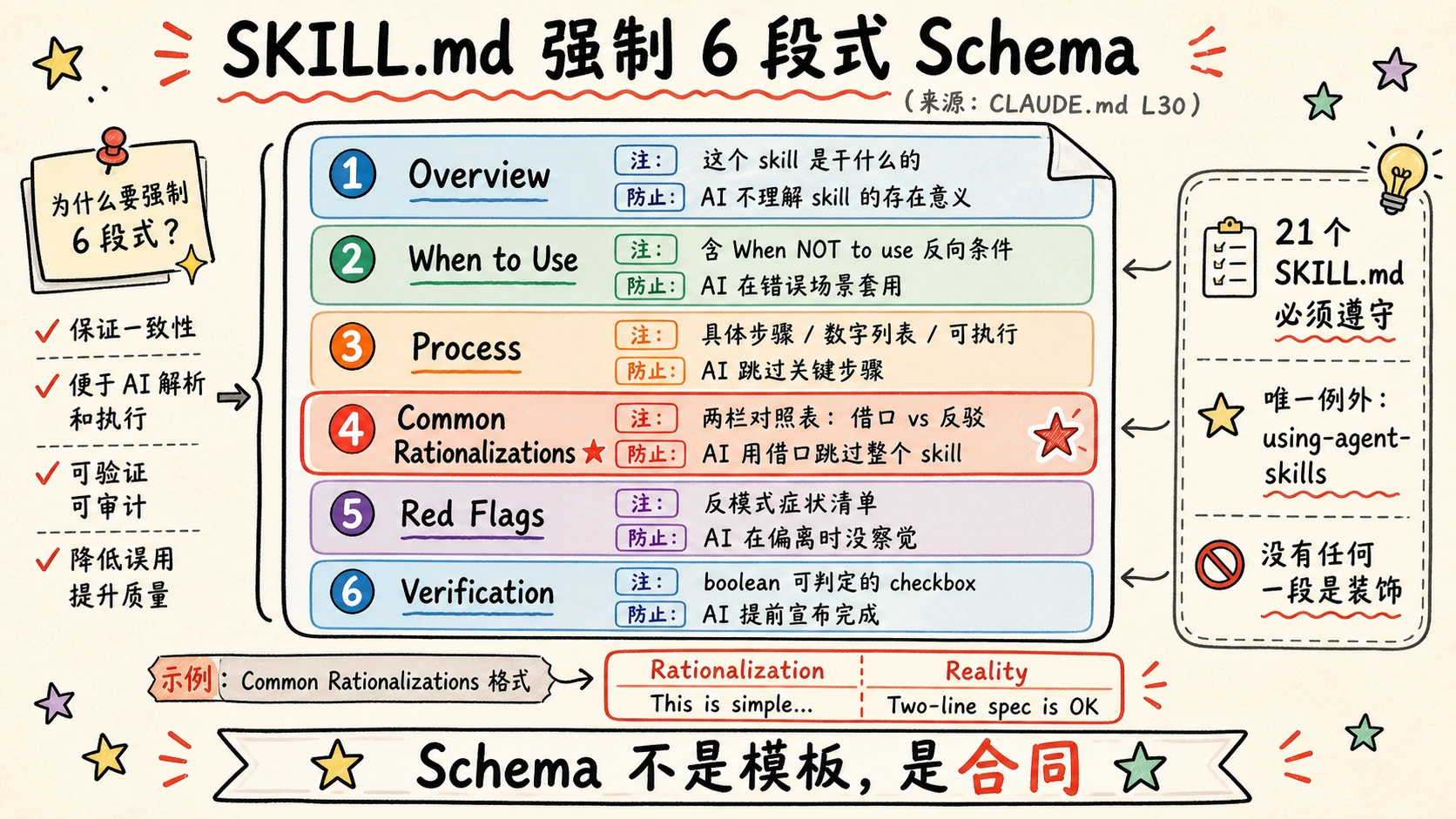
每一段对应一个 AI 可能犯的错:
| 段 | 防止什么 |
|---|---|
| Overview | AI 不理解 skill 的存在意义 |
| When to Use | AI 在错误场景套用 |
| Process | AI 跳过关键步骤 |
| Common Rationalizations | AI 用借口跳过整个 skill |
| Red Flags | AI 在偏离时没察觉 |
| Verification | AI 提前宣布完成 |
6.4 代表性 Skill 逐项拆解
6.4.1 spec-driven-development(教科书级 Process)
Process 段的 gated workflow:
| |
关键约束:Do not advance to the next phase until the current one is validated.
Phase 1 (Specify) 的 5 个技巧:
- Surface Assumptions — 显式列假设,末尾加
→ Correct me now or I'll proceed with these. - Six core areas — Objective / Commands / Project Structure / Code Style / Testing Strategy / Boundaries
- 三层 Boundaries — Always do / Ask first / Never do
- Reframe instructions as success criteria — “Make it faster” → “LCP < 2.5s on 4G”
- Spec template — 可复用 Markdown 模板
Spec template:
| |
Common Rationalizations 表的设计模式:
| Rationalization | Reality |
|---|---|
| “This is simple, I don’t need a spec” | Simple tasks need acceptance criteria, just shorter spec. |
| “I’ll write the spec after I code it” | That’s documentation, not specification. |
| “The spec will slow us down” | 15-minute spec prevents hours of rework. |
| “Requirements will change anyway” | That’s why the spec is a living document. |
| “The user knows what they want” | Even clear requests have implicit assumptions. |
这是整个仓库里 Common Rationalizations 的范本——预判 AI 会用什么理由跳过 skill,每条反驳一句话见血。
Verification checklist:
| |
关键设计:每一条都是 boolean 可判定(yes/no),没有"足够好"这种模糊词。最后一条 saved to a file 把 spec 从"对话产物"提升为"仓库产物"。
6.4.2 using-agent-skills(schema 例外)
这是唯一不遵守 6 段式 schema 的 skill,详见 Layer 1 节。
6.4.3 code-simplification(为 hook 服务的 skill)
这是少数有专门 hook 配套的 skill 之一(hooks/simplify-ignore.sh),它有特殊约束——保护代码块不能被简化。
/code-simplify 命令的步骤序列(来自 .claude/commands/code-simplify.md):
| |
6.5 Common Rationalizations 表的设计精髓
每个 skill 末尾的 Common Rationalizations 表是 agent-skills 最具识别度的设计模式。它的设计要点:
- 预判 AI 偷懒的理由——AI 在长 context 里会发明各种跳过 skill 的借口
- 每条反驳很短——一句话见血,不啰嗦
- 两栏对照格式——把"AI 的内心独白"和"事实"并置,制造认知摩擦
| |
6.6 Red Flags vs Common Rationalizations 的分工
| |
举例:
- Rationalization: “I’ll write the spec after I code it”
- Red Flag: “Starting to write code without any written requirements”
两者本质相同,但作用时机不同:
- Rationalization 在 AI 即将偷懒时拦截"念头"
- Red Flag 在 AI 已经偷懒时识别"症状"
6.7 Verification checklist 的可判定原则
每个 skill 的 Verification 段都是 boolean 可判定的 checkbox:
- ✓ “The spec covers all six core areas” — yes/no
- ✓ “The human has reviewed and approved” — yes/no
- ✗ “The spec is good enough” — 不可接受(模糊)
- ✗ “The reviewer is satisfied” — 不可接受(模糊)
6.8 100 行拆分阈值的应用
CLAUDE.md 规定 “Supporting files only created when content exceeds 100 lines”。这一规则的应用边界:
| 场景 | 是否拆出去 |
|---|---|
| spec-driven-development 的 Process 段 200 行 | 不拆 — 是方法论而非数据 |
| security checklist 134 行 | 拆 — 是清单数据 |
| orchestration patterns 370 行 | 拆 — 是模式目录 |
| 单个 skill 的几十行 Process | 不拆 — 维持自包含 |
关键判断:100 行是 “data vs methodology” 的分界线,不是文件长度的硬上限。
6.9 注意事项
using-agent-skills不遵守 schema 但没有显式声明例外——这是仓库的隐性约定- Skill 之间通过 description 匹配自动激活——所以 description 写法很重要(“动词短语 + 触发条件”)
- Skill 不能直接调用其他 skill——必须通过 command 或用户来编排
- 每个 skill 是自包含的——但可以指向 reference 和其他 skill
6.10 经验与可复用模板
写 Skill 的检查清单
| |
7. Layer 5|references/
7.1 定位与体量
- 目录路径:
references/ - 文件数:5 个
.md文件 - 行数范围:134-370 行
- 加载时机:被 skill 文件以"自然语言路径"指向后,由 AI 按需 Read
- 角色:数据层 / 清单 / 模式目录
- 关键特性:所有文件没有 YAML frontmatter——不被自动发现,不被自动加载
7.2 完整文件清单
| 文件 | 行数 | 类型 | 被谁引用 |
|---|---|---|---|
| accessibility-checklist.md | 160 | Checklist | frontend-ui-engineering, shipping-and-launch |
| performance-checklist.md | 153 | Checklist | performance-optimization, code-review-and-quality, shipping-and-launch |
| security-checklist.md | 134 | Checklist | security-and-hardening, code-review-and-quality, shipping-and-launch |
| testing-patterns.md | 236 | Pattern Catalog | test-driven-development |
| orchestration-patterns.md | 370 | Pattern Catalog | doubt-driven-development(×2), agents/README.md(×3), commands/ship.md |
7.3 两种 Reference 的功能分化
7.3.1 Checklist 类(security / performance / accessibility)
形态: 复选框任务列表,按主题分组。
例:security-checklist.md 节选:
| |
特点:
- 复选框 → 显式 “做过/没做” 二元状态
- 每条都是可验证条件(含具体参数:
≥12 rounds、≤10 attempts per 15 minutes) - 按主题分组(Auth / Authz / Input Validation / Headers…)
- 末尾常带工具命令(
git diff --cached | grep -i "password...")
触发点: 上线前、review 时。
7.3.2 Pattern Catalog 类(testing-patterns / orchestration-patterns)
形态: 正例 + 反例 + 决策表。
例:orchestration-patterns.md 节选:
| |
特点:
- 命名模式(A / B / C),便于交叉引用
- 每个模式包含:图示、用例、成本、反信号
- 显式列出 anti-patterns
- 偏架构 / 战略,而非战术
7.4 引用机制:纯文本路径
跨仓库的引用模式高度一致:
| |
没有任何自动加载机制:
- 不是
include指令 - 不是 frontmatter 字段
- 不是 MCP 资源
- 不是 Skill 自动激活
就是一句"自然语言路径"。AI 读到这句话,自己判断是否需要 Read。
这种"软引用"的好处
- AI 决定权重:context 紧张时可以不读
- 透明可控:用户可以看到哪些 reference 被读了
- 跨工具兼容:在任何能读文件的环境都能工作
7.5 orchestration-patterns.md 的特殊地位
这是 5 个 reference 里最特殊的一个:
- 行数最多:370 行(比其他 reference 多 2-3 倍)
- 被引用最多:被 commands、agents、skills 三层都引用
- 职责不同:其他 reference 是"任务时查",这个是"架构演化时查"
它的核心一句话被整个仓库反复引用:
The user (or a slash command) is the orchestrator. Personas do not invoke other personas.
7.6 设计取舍
取舍 1: 为什么不把 references 写进 skill?
如果把 134-370 行的清单全塞进 skill:
| 坏处 | 说明 |
|---|---|
| context 浪费 | 每次激活 skill 都加载几百行清单 |
| 概念混杂 | 方法论(process)和数据(checklist)写在一起 |
| 复用困难 | security checklist 要被 3 个 skill 共用,写在 skill 里就得复制三份 |
| 更新成本 | 清单变了要改三个 skill |
所以拆出去的真正动机是:复用 + 按需加载 + 关注点分离。
取舍 2: 100 行阈值
CLAUDE.md 规定:
Supporting files only created when content exceeds 100 lines
5 个 reference 的最小行数是 134(security-checklist),刚刚超过阈值。这说明阈值是有意控制的——不超过 100 行的内容应该直接写在 skill 里。
7.7 注意事项
- 没有 frontmatter:不能被 Skill 系统自动检索;只能靠 skill 里硬编码路径
- 没有 README/index:5 个文件没有总目录,AI 不易"发现"未引用的 reference
- 没有版本号:security checklist 的
bcrypt ≥12 rounds这类参数会过时,但没有 last-updated 日期 - 没有交叉引用:security 和 performance 之间偶尔有重叠(如 dependency security),但没互链
7.8 经验与可复用模板
何时建一个 reference 文件
| |
Checklist 类 Reference 模板
| |
Pattern Catalog 类 Reference 模板
| |
8. Layer X|hooks/
8.1 定位与体量
- 目录路径:
hooks/ - 文件数:3 个 hook 脚本 + 2 个文档 + 2 个测试 + 1 个配置
- 总行数:1052 行
- 加载时机:由 Claude Code 在特定事件触发
- 角色:横切关注点(AOP)——在不修改 skill 的前提下增强 skill
8.2 完整文件清单
| 文件 | 行数 | 角色 |
|---|---|---|
| hooks.json | 14 | 插件级注册(仅 session-start) |
| session-start.sh | 24 | Hook 1: 会话启动 |
| session-start-test.sh | 46 | 测试 |
| sdd-cache-pre.sh | 106 | Hook 2: WebFetch 前 |
| sdd-cache-post.sh | 135 | Hook 2: WebFetch 后 |
| SDD-CACHE.md | 167 | 文档 |
| simplify-ignore.sh | 302 | Hook 3: 代码屏蔽 |
| simplify-ignore-test.sh | 247 | 测试 |
| SIMPLIFY-IGNORE.md | 90 | 文档 |
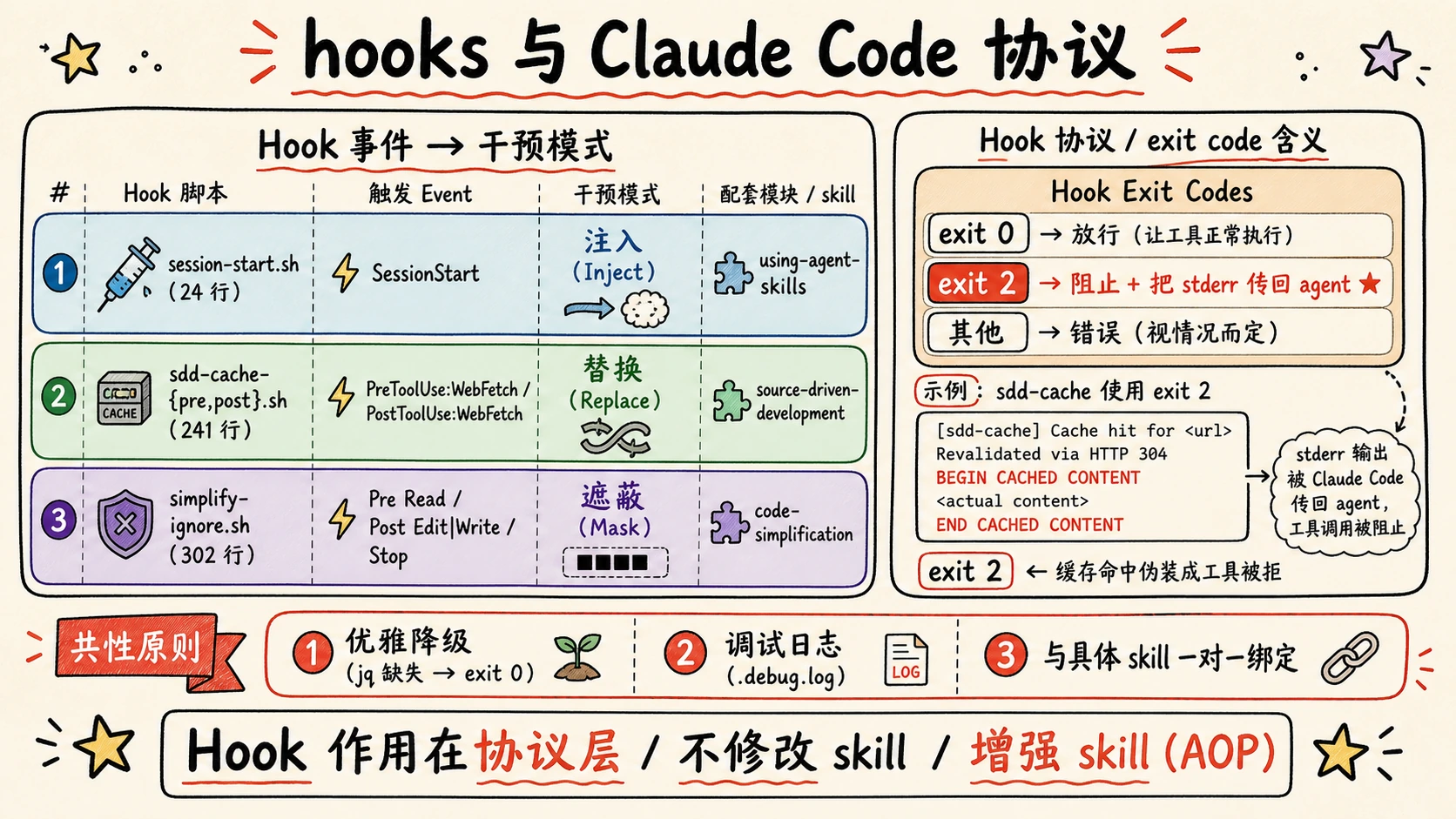
8.3 三种干预模式
| Hook | 触发事件 | 干预方式 | 配套 Skill |
|---|---|---|---|
| session-start | SessionStart | 注入 context | using-agent-skills |
| sdd-cache | PreToolUse:WebFetch + PostToolUse:WebFetch | 替换 工具输出 | source-driven-development |
| simplify-ignore | PreToolUse:Read + PostToolUse:Edit|Write + Stop | 遮蔽 工具输入 | code-simplification |
8.4 Hook 1: session-start
8.4.1 注册(hooks.json)
| |
8.4.2 完整脚本(session-start.sh,24 行)
| |
8.4.3 作用
每个新会话启动时,把 using-agent-skills/SKILL.md 的全部 180 行注入到第一条 system message 里。
8.4.4 优雅降级
| |
jq 缺失时输出友好提示,不报错退出。会话仍能继续,只是 meta-skill 不被注入。
8.5 Hook 2: sdd-cache
8.5.1 注册(用户级 .claude/settings.json)
| |
8.5.2 核心矛盾
source-driven-developmentskill 要求每个框架决策都 fetch 官方文档- 同一个项目跨会话工作意味着反复 fetch 同一个页面
- 简单缓存会破坏 skill 的"always verify against current docs"承诺
8.5.3 解决方案:HTTP 协议感知的缓存
| |
8.5.4 关键代码片段(sdd-cache-pre.sh)
1)依赖检查 + 优雅降级(第 21-23 行):
| |
2)没有验证器就不缓存(第 62-65 行):
| |
3)HEAD 重验证(第 71-74 行):
| |
4)exit 2 当作 in-band 信号(第 94-106 行):
| |
8.5.5 三个绝妙的设计
1)exit 2 当作 in-band 信号
Claude Code 的 hook 协议里,exit 2 = 阻止工具执行 + 把 stderr 传回 AI。sdd-cache 利用这个机制,把"缓存命中"伪装成"工具被拒"——但 stderr 里其实是有效内容。
2)没有 ETag/Last-Modified 就拒绝缓存
没有验证器的内容永不缓存。避免"缓存了但永远不知道何时该失效"的状态。
3)缓存原始 prompt
WebFetch 不返回原始 HTML,返回的是经过模型按 prompt 处理过的内容。缓存命中时把原始 prompt 也返回给 AI——让 AI 自己判断"上次的提问角度对当前任务够不够"。
8.5.6 缓存条目结构
| |
存放在 .claude/sdd-cache/<sha256(url)>.json。
8.5.7 已知限制
- Body is prompt-shaped:缓存的不是原始 HTML,是上次 prompt 处理过的内容
- Every cache write costs an extra HEAD:post hook 需要再发一次 HEAD 取 ETag
- Servers without ETag or Last-Modified are never cached:没有验证器的站点永远不被缓存
- A misbehaving server can serve a wrong 304:服务器 bug 会导致缓存陈旧
8.6 Hook 3: simplify-ignore
8.6.1 注册(用户级 .claude/settings.json)
| |
8.6.2 注解语法
| |
经过 hook 处理后,模型 read 到的是:
| |
8.6.3 三阶段生命周期
| Event | Action |
|---|---|
PreToolUse Read | 备份原文件 + 替换为 BLOCK_<hash> 占位符 |
PostToolUse Edit|Write | 展开占位符回到真实代码 + 保存模型修改 |
Stop(会话结束) | 从备份恢复所有被保护的文件 |
8.6.4 内容哈希作为占位符 ID
| |
即使模型把占位符复制、移位、删除,hash 仍能精确定位回原代码。
8.6.5 渐进式回填
Fallback expansion is progressive: full placeholder → prefix+hash+suffix → hash-only.
模型如果修改了占位符格式(比如改了 reason 文本),hook 会用越来越宽松的匹配模式尝试还原。
8.6.6 崩溃恢复
| |
8.6.7 已知限制
- Single-line blocks hide the entire line:单行注解会隐藏整行
- Comment suffix detection only covers
*/and-->:模板引擎(ERB、Blade)可能不工作 - Fallback is progressive, not exact:模型修改占位符格式时可能留下美容性残留
- File renaming leaves placeholders:模型用 shell rename 文件,新文件会保留占位符
8.7 三个 Hook 的共性设计
共性 1: 优雅降级
| |
任何 hook 都不应该让 session 卡死。依赖缺失时静默退出 0。
共性 2: 显式调试日志
| |
通过环境变量或 sentinel 文件触发日志——hook 是黑盒,必须留可观察性。
共性 3: 与具体 skill 一对一绑定
| Hook | 配套 Skill | 失败影响 |
|---|---|---|
| session-start | using-agent-skills | skill 系统不可用 |
| sdd-cache | source-driven-development | 重复 fetch(仅性能损失) |
| simplify-ignore | code-simplification | 保护代码被改(数据损失风险) |
共性 4: 文档专门解释"反直觉"行为
- sdd-cache:“exit 2 不是故障,是缓存命中”
- simplify-ignore:“模型看到 BLOCK 占位符是正确行为”
- session-start:“jq 缺失时 skills 仍可用”
每个 hook 都假设读者会困惑,主动消除困惑。
8.8 注册的两层架构
插件层(hooks.json)
| |
只注册了 session-start。这是仓库默认的、所有用户都需要的 hook。
项目层(.claude/settings.json)
| |
sdd-cache 和 simplify-ignore 必须由用户手动注册。
设计逻辑
| Hook | 默认启用 | 理由 |
|---|---|---|
| session-start | ✓ | 整个 skill 系统的"启动器"——不启用整个仓库无意义 |
| sdd-cache | ✗ | 性能优化,有 disk I/O + 网络 HEAD 开销,opt-in |
| simplify-ignore | ✗ | 改变模型可见性,有数据风险,opt-in |
原则:默认开启的 hook 必须是"无副作用 + 无 opt-out 成本"的。
8.9 Hook 的核心哲学
哲学 1: 不修改 skill,增强 skill
SDD-CACHE.md 引文:
The skill itself is unchanged. It continues to follow
DETECT → FETCH → IMPLEMENT → CITE. The hook only changes what happens under the hood whenFETCHruns.
这是"hook 作为运行时优化器"的范式——比修改 skill 本身可维护性高得多。
哲学 2: 利用协议而非绕过
sdd-cache 没有 hack 出新的通信渠道,而是精确地用了 Claude Code hook 协议里 exit code 2 的含义。
Hook 应该作用在协议层,不应该作用在语义层。
哲学 3: 失败模式必须显式
每个 hook 都有:
- 依赖缺失的降级策略
- 调试日志
- 崩溃恢复路径
- “看似异常但其实正常"的解释
Hook 是 invisible infrastructure——所以必须留观察接口。
8.10 注意事项
- 没有 hook 失败的告警机制:sdd-cache 静默 exit 0 时,用户无从知道缓存功能没生效
- simplify-ignore 没覆盖 MultiEdit:matcher 只匹配
Edit|Write,但 Claude Code 还有 MultiEdit 工具 - 没有 hook 之间的依赖声明:如果 simplify-ignore 和某个未来 hook 同时操作 Read,行为是未定义的
- session-start 强制注入 180 行:每个会话首条 message 都吃 ~2K token
8.11 经验与可复用 Hook 模板
| |
9. 索引与速查
9.1 跨层级关键文件速查
| 我想知道 | 看哪个文件 |
|---|---|
| 仓库整体定位 | CLAUDE.md |
| 所有 skill 的清单 | CLAUDE.md § Skills by Phase / skills/using-agent-skills/SKILL.md § Quick Reference |
| 任务路由决策树 | skills/using-agent-skills/SKILL.md § Skill Discovery |
| AI 不该做什么 | skills/using-agent-skills/SKILL.md § Failure Modes |
| 上线前完整 checklist | skills/shipping-and-launch/SKILL.md |
| 安全检查清单 | references/security-checklist.md |
| 性能检查清单 | references/performance-checklist.md |
| 多 agent 编排模式 | references/orchestration-patterns.md |
| Persona 设计规则 | agents/README.md |
| Hook 协议(exit code 含义) | hooks/SDD-CACHE.md |
| Spec 写作模板 | skills/spec-driven-development/SKILL.md |
| Common Rationalizations 表设计 | 任一 skill 的对应段(参考 spec-driven-development) |
9.2 设计哲学速查
| 哲学 | 来源 | 体现 |
|---|---|---|
| Never Duplicate | CLAUDE.md L43 | 整个仓库的"指针架构” |
| 利用协议而非绕过 | hooks 设计 | exit code 2、ASCII 决策树、Markdown 模板 |
| 反例教学 | agents/README.md | meta-orchestrator 反例、每个 skill 的 Red Flags |
| 100 行拆分阈值 | CLAUDE.md L32 | references 拆出 skill |
| 总在 context 必须极短 | CLAUDE.md 自身 44 行 | 按需加载架构 |
| 用约束代替能力 | 整个项目 | 用 skill 强制纪律,不期待模型自觉 |
| User is the orchestrator | agents/README.md(重复 5+ 次) | personas 不互调 |
9.3 “我想做 X,该看哪里” 反向索引
| 想做的事 | 该查的层 / 文件 |
|---|---|
| 给我的项目写一份 CLAUDE.md | Layer 0 § 2.6 模板 |
| 给我的团队定义工程纪律的 skill | Layer 4 § 6.10 模板 |
| 加一个我的项目专用的 slash command | Layer 2 § 4.9 模板 |
| 加一个 specialist persona | Layer 3 § 5.10 模板 |
| 拆数据到 reference 文件 | Layer 5 § 7.8 模板 |
| 加自定义 hook | Layer X § 8.11 模板 |
| 决定要不要新建 persona | Layer 3 § 5.10 判定标准 |
| 决定要不要新建 reference | Layer 5 § 7.8 判定标准 |
| 设计一个 fan-out 命令 | .claude/commands/ship.md 模式 |
| 把模糊需求翻译成可验证条件 | skills/spec-driven-development/SKILL.md § “Reframe instructions” |
| 写 AI 看的"反合理化"表 | skills/spec-driven-development/SKILL.md § Common Rationalizations |
9.4 各层文件数量与体量对比
| |
9.5 隐藏的"对齐 bug"
仓库中存在一些有意识的或可能的设计不一致:
| 不一致点 | 描述 |
|---|---|
code-simplification 缺失 | 出现在 CLAUDE.md Skills by Phase 中,但 using-agent-skills 决策树没有 |
deprecation-and-migration 缺失 | 类似情况 |
| using-agent-skills 不遵守 schema | 没有在 CLAUDE.md 显式声明此例外 |
| skill-anatomy.md 路径未给 | CLAUDE.md Boundary 引用了它但没说在哪里 |
| simplify-ignore 不覆盖 MultiEdit | matcher 只配置了 Edit|Write |
9.6 阅读 agent-skills 的建议路径
路径 A:从外向内(推荐)
| |
路径 B:从某个具体场景反向追
| |
附录 A:术语表
| 术语 | 含义 |
|---|---|
| Skill | 一个 SKILL.md 文件,定义某个工程任务的方法论 |
| Persona | 一个 .md 文件,定义一个 subagent 的角色与输出格式 |
| Command | 一个 slash command 文件,定义用户显式触发的入口 |
| Reference | 不带 frontmatter 的支撑文档,通常是清单或模式目录 |
| Hook | Bash 脚本,在 Claude Code 的特定事件触发 |
| meta-skill | using-agent-skills,治理其他 skill 的元规则 |
| fan-out | 并行 spawn 多个 subagent,各自独立工作 |
| Common Rationalizations | skill 中的"AI 借口反驳表" |
| Red Flags | skill 中的"AI 偏离症状清单" |
| Verification | skill 中的 boolean 可判定完成条件 |
| schema | CLAUDE.md L30 强制的 SKILL.md 6 段结构 |
| lazy loading | references 的"软引用"加载方式 |
附录 B:仓库地址与版本
- GitHub: https://github.com/addyosmani/agent-skills
- 作者: Addy Osmani (Google)
- 本手册基于的代码状态: main branch(2026 年 5 月)
如果你想看叙事版本和鬼哥的学习思考,翻 文章型《从使用者到学习者》。
如果你想看 Addy 项目的整体定位和反合理化机制,翻 《Agent Skills:当 Google 工程文化遇上 AI 编程代理》。